PDP-1
PDP-1: the interactive computer that brought Spacewar! to life
At the beginning of the 1960s, using a computer still often meant preparing a program, handing it to an operator, and waiting for the printed results. Programmers rarely interacted directly with the machine: they submitted a job and received the output later.
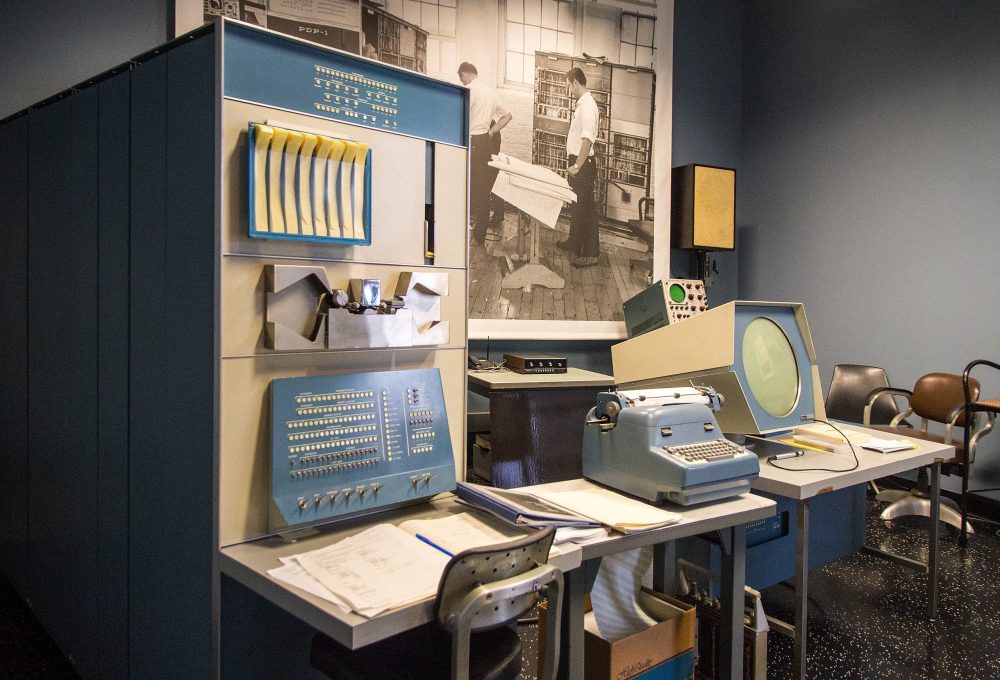
The PDP-1, or Programmed Data Processor-1, offered a different relationship with computing. With its console typewriter, punched-tape reader, control panel and optional graphical display, users could load a program, observe its execution and interact directly with the machine.
Designed by Digital Equipment Corporation, the PDP-1 became one of the emblematic machines of early interactive computing. Its influence went far beyond its limited production run. It hosted graphical experiments, computer-generated music and, most famously, Spacewar!, one of the earliest video games in computing history.
Quick facts
- Name: PDP-1 — Programmed Data Processor-1
- Manufacturer: Digital Equipment Corporation
- Prototype unveiled: December 1959
- Commercial launch: 1960
- Principal designer: Benjamin Gurley
- Architecture: 18-bit computer
- Standard memory: 4,096 words
- Memory cycle: approximately 5 microseconds
- Typical speed: approximately 100,000 additions per second
- Launch price: approximately $120,000
- Production: just over fifty units
- Famous applications: scientific research, graphics, music and Spacewar!
The problem: powerful computers, but distant from their users
At the end of the 1950s, computing was still dominated by large central systems. These machines were expensive, occupied dedicated rooms and were usually operated by specialised staff.
In a batch-processing environment, programmers prepared cards or tapes, submitted their jobs and waited for them to reach the front of the execution queue. A simple error could mean correcting the program and starting the entire process again.
Research laboratories such as the MIT Lincoln Laboratory were exploring another approach. Experimental computers such as the TX-0 and TX-2 demonstrated that a person could work directly with a computer and receive an immediate response.
The PDP-1 brought this philosophy to a commercial product. It did not remove every limitation of early computing, but it greatly reduced the distance between programmer and machine.
Designing the PDP-1
The PDP-1 was the first computer marketed by DEC. Engineer Benjamin Gurley led its design and completed much of the project within a few months, drawing on experience gained from the TX-0 and TX-2.
The machine used DEC’s transistor-based electronic modules. This modular design simplified construction and maintenance while making it easier to connect different peripherals.
Research company Bolt, Beranek and Newman, better known as BBN, acquired the first production PDP-1. BBN engineers subsequently explored and developed several interactive uses for the machine.
A PDP-1 also arrived at MIT in the early 1960s. Professor Jack Dennis allowed students and programmers considerable freedom to use it. This unusual level of access encouraged experimentation and helped create a distinctive culture around interactive computing.
How did the PDP-1 work?
The PDP-1 processed 18-bit words. Its standard configuration contained 4,096 words stored in magnetic-core memory.
An 18-bit word could hold either an instruction or data. The processor fetched an instruction from memory, determined the required operation and then performed it on the relevant data.
The PDP-1 included:
- an accumulator used for calculations;
- an input-output register for communicating with peripherals;
- a program counter containing the address of the next instruction;
- magnetic-core memory;
- a relatively compact instruction set.
Its speed is tiny by modern standards, but the PDP-1 could perform approximately 100,000 additions per second. For contemporary users, however, raw computing power was only part of its appeal. Direct access to the machine was just as important.
What was it actually like to use a PDP-1?
To load a program, users generally placed a punched paper tape in the reader. Holes in the tape encoded the program’s instructions and data.
After positioning the tape, the user operated controls on the front panel to start the loading process. The computer then transferred the program into magnetic-core memory.
Indicator lights on the control panel displayed the state of several registers. Switches allowed users to enter values manually, select an address or start execution from a particular memory location.
The Soroban console typewriter acted as a rudimentary terminal. Users could enter characters and programs could print responses. However, this electromechanical device was slow and notoriously difficult to maintain.
A typical session might therefore involve:
- placing a punched tape in the reader;
- loading the program into memory;
- selecting its starting address;
- starting execution;
- watching the indicator lights, typewriter or display;
- stopping the program to inspect or modify its state;
- correcting the program and trying again.
This immediate cycle of testing, observation and correction was one of the major differences between interactive computing and traditional batch processing.
The PDP-1 versus a large batch-processing computer
| Large batch-processing system | PDP-1 |
|---|---|
| Programs usually submitted to an operator | Programmer could access the machine directly |
| Results often obtained after a delay | Results could be observed immediately |
| Use organised around a queue of jobs | Experimental and interactive use |
| Very expensive central installation | More compact, although still intended for institutions |
| Output mainly textual or printed | Graphical output possible with the Type 30 |
This comparison needs some qualification. Not every large computer operated exclusively in batch mode, and experimental interactive computers existed before the PDP-1.
The Type 30: turning the PDP-1 into a graphical computer
One of the PDP-1’s most famous peripherals was the Precision CRT Display Type 30.
This cathode-ray tube display did not work like a modern screen built from a permanent grid of pixels. Instead, the program supplied X and Y coordinates and the display illuminated a point at the requested position.
By repeating this operation up to approximately 20,000 times per second, the PDP-1 could construct shapes, curves, text and animations.
The Type 30 could also use a light pen. When the user placed the pen in front of an illuminated point, it sent a signal back to the program. Users could therefore select graphical elements directly on the screen, years before the computer mouse became widespread.
The Type 30 played a major role in the PDP-1’s graphical experiments, although it remained an expensive optional peripheral.
Spacewar!: the program that made the PDP-1 famous
The PDP-1 is most closely associated with Spacewar!, one of the earliest video games created for a digital computer.
The project was conceived in 1961 by Steve Russell, Martin Graetz and Wayne Wiitanen. Steve Russell programmed the first version on MIT’s PDP-1. By the spring of 1962, the game had received major improvements from programmers including Peter Samson, Dan Edwards and Martin Graetz.
Two players each control a spacecraft. They must avoid their opponent’s shots while dealing with the gravitational pull of a star located in the centre of the screen.
The PDP-1 continuously recalculates:
- the positions of both spacecraft;
- their movement and rotation;
- the trajectories of projectiles;
- the effect of gravity;
- the positions of the stars displayed in the background.
The result appears immediately on the Type 30 display. Dedicated control boxes were eventually built so that players no longer had to manipulate the console switches directly.
Spacewar! demonstrated that a computer could serve purposes beyond scientific and administrative calculation. It could also become a platform for creativity, simulation and entertainment.
The PDP-1 as a musical instrument
MIT users also explored the PDP-1’s sound capabilities. By rapidly controlling an electronic output connected to an amplifier, a program could generate audible frequencies.
Student Peter Samson developed the idea further and produced polyphonic computer music with several notes playing simultaneously. He created the Harmony Compiler, a program that made it easier to describe musical scores for the PDP-1.
Works by Bach and Mozart were adapted for the machine. These experiments introduced another way of thinking about computers: not simply as calculating devices, but as programmable instruments.
This modern demonstration features an interpretation of Olson by Boards of Canada performed on a PDP-1. It provides a concrete example of the kind of programmed music this historic computer can produce.
The limitations of the PDP-1
Despite its innovative character, the PDP-1 remained very different from a modern personal computer.
- Price: approximately $120,000 in 1960, excluding some optional peripherals.
- Memory: only 4,096 words in the standard configuration.
- Storage: punched tape was slow and inconvenient for editing or organising programs.
- Display: software had to continuously refresh the Type 30.
- Programming: programs were written very close to the machine’s hardware architecture.
- Production: only about fifty systems were built.
The PDP-1 therefore did not bring computing to the general public. Instead, it made direct access to a computer much more practical for laboratories, universities and certain companies.
Common misconceptions about the PDP-1
“The PDP-1 was the first interactive computer.”
Experimental machines such as Whirlwind, the TX-0 and TX-2 already provided forms of direct interaction. The PDP-1 is more accurately described as one of the earliest commercially available interactive computers.
“The PDP-1 was a personal computer.”
One person could use the machine directly, but its price and physical size restricted it to institutions. It is better understood as an important precursor to personal computing.
“Spacewar! was unquestionably the first video game.”
Earlier experimental electronic games existed. Spacewar! is more accurately described as one of the earliest digital computer games to achieve significant circulation among programmers.
“The PDP-1 invented the minicomputer.”
It contributed to the emergence of this category, but the term and the minicomputer market became firmly established with later machines, especially the PDP-8.
Why the PDP-1 remains an important computer
The historical importance of the PDP-1 does not come from the number of machines sold. It comes from the computing culture that developed around it.
- Direct interaction: programmers could use the machine without always submitting jobs through a batch-processing queue.
- Experimental programming: errors could be observed and corrected much more quickly.
- Graphics: the Type 30 could produce real-time images and animations.
- Digital creativity: Spacewar! and musical experiments demonstrated entirely new uses for computers.
- Hacker culture: MIT users explored and repurposed the machine far beyond its original applications.
- Industrial legacy: the PDP-1 opened DEC’s long-running family of PDP computers.
The PDP-1 was not, by itself, the origin of interactive computing. It nevertheless represents an important moment in computing history: computers were beginning to become machines that people could directly explore, program and use creatively.
Timeline
- December 1959: PDP-1 prototype presented at the Eastern Joint Computer Conference.
- 1960: DEC commercially launches the PDP-1.
- November 1960: an early production system is delivered to BBN.
- Early 1960s: a PDP-1 becomes available in the MIT computing environment.
- 1961: Spacewar! is conceived and its first version begins to take shape.
- Spring 1962: several MIT programmers make major improvements to Spacewar!.
- 1960s: the PDP-1 hosts graphical, musical and scientific applications as well as experiments in time-sharing.
- Late 1960s: the PDP-1 reaches the end of its commercial life.
Further reading
To continue exploring the history of the PDP-1 and interactive computing:
Cover photo: Alexey Komarov — CC BY-SA 4.0.