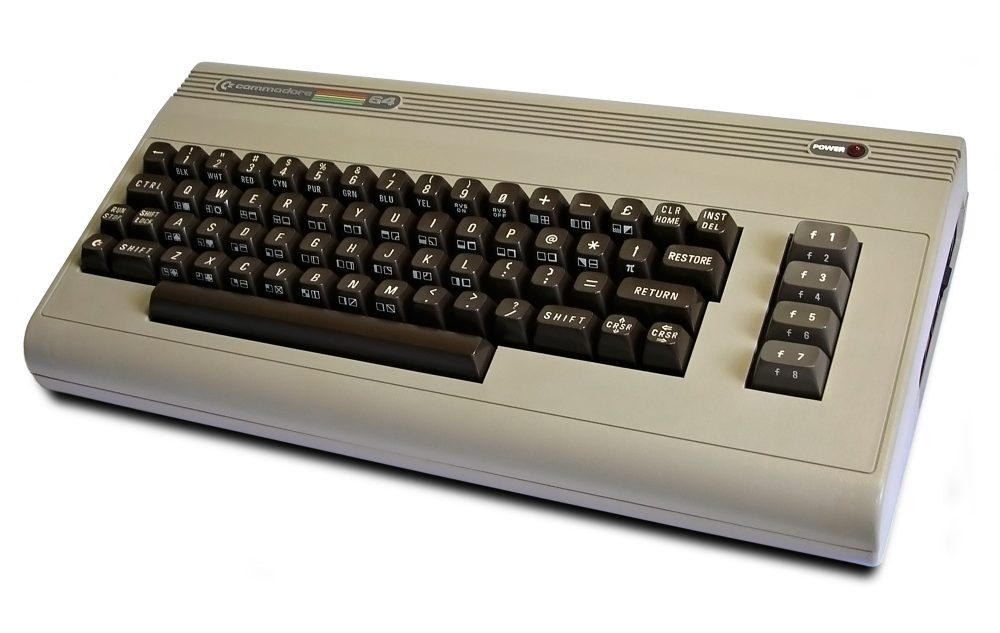
Commodore 64
But the C64’s success was not based on memory alone. Commodore controlled the production of many of its own electronic components. This allowed the company to offer an ambitious machine at a particularly aggressive price.
The Commodore 64 became a games machine, a family computer and an introduction to programming. It also attracted programmers who wanted direct access to the hardware. Its long commercial life and enormous software library eventually made it one of the defining computers of the 1980s.
A computer designed for the mass market
When Commodore developed the C64, the company had a major advantage over many of its competitors. It controlled MOS Technology, which manufactured several of the key chips used in Commodore computers.
The processor, interface chips, video controller and sound synthesizer could therefore be produced within the same industrial group. This vertical integration helped Commodore reduce manufacturing costs.
An aggressive price war
Commodore adopted a very aggressive pricing strategy from the start. In the United States, the C64 was introduced in 1982 with a price of $595. The price was already competitive for a machine with 64 KB of RAM and dedicated graphics and sound hardware.
The price then fell dramatically. By May 1983, the American retail price had already dropped to around $250.
Prices varied across Europe. In the United Kingdom, the C64 initially sold for around £399. By February 1983, however, Commodore was already advertising it for £299.
In France, the machine cost roughly 4,000 francs when it arrived in 1983. Prices later depended on the video configuration. In 1984, for example, a French advertisement offered a PAL C64 for 2,990 francs, a version with a SCART interface for 3,650 francs, and a model with integrated SECAM support for 3,990 francs.
The cost of peripherals
The price of the computer itself tells only part of the story. A family television could be used as a display, but peripherals represented a substantial additional expense.
In France, the Commodore 1541 floppy disk drive was still advertised for 3,380 francs in 1984. It therefore cost more than the PAL C64 itself. For many users, cassette storage remained a much more affordable solution.
Distribution beyond computer shops
Commodore did not restrict the C64 to specialist computer stores. The machine also appeared in department stores, toy shops and consumer electronics chains.
This strategy exposed the computer to a much wider audience and contributed significantly to its success, particularly in North America and Europe.
An 8-bit architecture built around the MOS 6510
At the heart of the machine is the MOS Technology 6510, a variant of the famous MOS 6502. It is an 8-bit processor with a 16-bit address bus.
The processor can therefore address 65,536 locations, giving it a total address space of 64 KB.
Its clock speed is close to 1 MHz. PAL machines run at approximately 0.985 MHz, while NTSC versions operate at around 1.023 MHz.
The 6510 differs from the 6502 mainly through its integrated input/output port. In the Commodore 64, this port participates in memory configuration. It helps determine which RAM, ROM or I/O areas are visible to the processor.
64 KB of RAM inside a 64 KB address space
The Commodore 64’s memory organisation creates an interesting paradox. The machine really contains 64 KB of RAM, which already fills the entire address space available to the 6510.
Yet the processor must also access the ROM containing BASIC and the operating system. It must also communicate with the video, sound and input/output hardware.
Commodore solves the problem by allowing different resources to appear in certain areas of the address space. Depending on the current configuration, the same CPU address can therefore provide access to RAM, ROM or a peripheral.
The $A000-$BFFF region, for example, can expose the BASIC ROM or the RAM located underneath it. Between $E000 and $FFFF, the KERNAL ROM can similarly be replaced by RAM.
The $D000-$DFFF area is even more flexible. It can provide access to I/O devices, the character-generator ROM or RAM.
This arrangement allows the C64 to contain a full 64 KB of RAM together with several ROMs and specialised chips, while the processor still sees no more than 64 KB at any one time.
The VIC-II: much more than a video controller
One of the Commodore 64’s greatest strengths is its VIC-II video chip. It generates the display and provides several hardware features particularly well suited to games and animation.
The standard text mode generally uses a 40-column by 25-line display. The VIC-II also supports high-resolution and multicolour graphics modes and provides a palette of 16 colours.
Its best-known feature is probably its support for eight hardware sprites. A sprite is a small graphic object that can move independently of the background.
Because part of the display work is performed directly by the VIC-II, the processor does not need to redraw an entire object every time it moves.
The chip also supports fine horizontal and vertical scrolling. Game developers made extensive use of these capabilities, and the demoscene would later push them far beyond their most obvious applications.
The VIC-II shares memory access with the processor. When it needs to fetch certain graphics data, it can temporarily take control of the memory bus. The 6510 must then wait.
The performance of the C64 therefore depends on more than the processor’s clock frequency. It also results from the close interaction between the CPU and the video hardware.
The SID: a synthesizer inside the computer
The other chip that gives the Commodore 64 its distinctive identity is the SID, or Sound Interface Device. Early machines mainly use the MOS 6581, while later revisions include the 8580.
The SID provides three independent voices. Each can generate different waveforms and includes frequency and envelope controls.
The chip also contains filtering capabilities. This allows it to produce sounds far more complex than the simple tone generators found in many contemporary computers.
Programmers and musicians quickly learned how to exploit this architecture. Some developed sophisticated techniques to simulate additional voices or create complex rhythmic effects.
Others used the analogue characteristics of the chip to create distinctive timbres. The SID effectively became a musical instrument in its own right.
Its sound remains so distinctive that it continues to influence chiptune music and compositions created with vintage computers.
The CIA 6526 chips and input/output
The Commodore 64 also contains two MOS 6526 CIA chips, where CIA stands for Complex Interface Adapter. They handle several input/output and timing functions.
These chips participate in keyboard scanning, joystick handling and serial communications. They also perform several other system-control functions.
The C64 therefore relies on close cooperation between the main processor and several specialised chips.
The machine includes two joystick ports using the DE-9 connector popularised by Atari. It also provides a user port, cartridge port and Commodore IEC serial interface. Connections are available for the cassette drive as well as several video outputs.
BASIC available immediately after power-up
When the Commodore 64 is switched on, it starts directly in Commodore BASIC 2.0. The user is immediately presented with an interactive programming environment.
A first program requires only a few lines:
10 PRINT "HELLO"
20 GOTO 10
This accessibility had considerable educational importance. For many users, the Commodore 64 provided their first experience of computer programming.
BASIC 2.0 nevertheless presents an interesting paradox. The C64 has impressive graphics and sound capabilities, but its BASIC provides very few high-level commands for controlling them directly.
It lacks, for example, the advanced graphics commands available in some competing BASIC dialects. To produce complex graphics or sound, programmers often need to manipulate hardware registers directly.
The PEEK and POKE instructions therefore become essential. They encourage many users to learn how the machine is organised internally. Some eventually move on to 6510 assembly language in search of greater performance and control.
The Commodore 1541: almost a computer of its own
The best-known storage device for the C64 is the Commodore 1541 floppy disk drive. It is not simply a mechanical drive controlled directly by the computer.
The 1541 contains its own electronics, its own processor from the 6502 family and its own memory. It even runs its own system software.
The drive is therefore almost a small autonomous computer connected to the C64 through Commodore’s serial bus. This design philosophy had already been used with the PET and VIC-20 families.
The main weakness of the 1541 is the poor speed of its standard operations. The communication protocol severely limits performance compared with what the hardware itself could theoretically achieve.
Programmers quickly developed fast loaders. These routines replace parts of the original communication protocol and can accelerate data transfers dramatically.
Some techniques go even further. They upload code directly into the 1541’s memory and use the drive’s own processor actively during data transfers.
Cassette, floppy disk and cartridges
The C64 supports several types of storage media. In Europe, the Datasette cassette drive remained widely used because of its low price.
Loading software from tape is slow, however, and can take several minutes. The 1541 disk drive provides much more convenient access to software and naturally allows files to be written as well as read.
Its price represents a significant expense compared with the computer itself. Many users therefore began with cassette storage.
The cartridge port provides a third option. It allows certain ROM-based programs and games to start immediately. Hardware expansions can also use this connector.
A machine particularly well suited to games
The combination of the VIC-II, SID, hardware sprites and 64 KB of RAM makes the Commodore 64 particularly suitable for video games.
Developers can produce colourful, animated games with sophisticated music while still targeting a relatively affordable computer.
Thousands of games were released for the platform. The catalogue includes arcade conversions as well as a huge number of original productions.
Action games, simulations, role-playing games and text or graphical adventures all found a home on the C64.
This enormous software library gradually became one of the machine’s strongest advantages. As the installed user base grew, publishers produced more software. As the catalogue expanded, the machine became even more attractive to new buyers.
An ecosystem far larger than games
Reducing the Commodore 64 to a games console with a keyboard would be misleading. The machine also received a large collection of software for more general uses.
Word processors, spreadsheets, educational programs and drawing tools were available. Users could also find databases, communications software and several programming languages.
Specialist magazines regularly printed programs for readers to type in themselves. User groups exchanged software, advice and documentation.
This culture of home programming became an important part of personal computing during the 1980s.
In 1986, the GEOS graphical environment demonstrated that an interface based on windows, icons, menus and a mouse could operate on an 8-bit machine with only 64 KB of RAM.
Despite the hardware limitations of the C64, developers managed to reproduce interface concepts then associated with much more expensive computers.
The C64 and the demoscene
The Commodore 64 also became one of the defining platforms of the demoscene. Groups of programmers, graphic artists and musicians created technical and artistic demonstrations.
Their goal was not necessarily to produce useful software. Instead, they tried to discover how far the hardware could be pushed.
This approach led them to exploit VIC-II and SID behaviours that had not always been anticipated by their designers.
Programmers synchronised code with the video raster, changed hardware registers at extremely precise moments and developed numerous techniques for overcoming the machine’s apparent limitations.
New demonstrations continue to appear decades after commercial production ended. Few home computers have maintained such an active technical community for so long.
From the “breadbin” to the C64C
The original Commodore 64 uses a rounded brown-and-beige case derived from the VIC-20. Its shape earned it the nickname “breadbin”.
In the mid-1980s, Commodore modernised the machine with the C64C. Its case became lighter, flatter and more angular.
The design moved closer to the style of Commodore’s next generation of computers. Despite the external redesign and several internal revisions, the general architecture remained compatible with the original C64.
Commodore also produced other versions of the platform. The SX-64, introduced in 1984, was a transportable version with a built-in colour display and floppy disk drive.
Key specifications
- Manufacturer: Commodore Business Machines
- Unveiled: January 1982
- Commercial release: 1982
- Processor: MOS Technology 6510
- Architecture: 8-bit
- Clock speed: approximately 0.985 MHz PAL and 1.023 MHz NTSC
- RAM: 64 KB
- Built-in language: Commodore BASIC 2.0
- Video chip: VIC-II
- Colour palette: 16 colours
- Hardware sprites: 8
- Sound chip: SID 6581, later 8580 in some revisions
- Sound voices: 3
- Interface chips: two MOS 6526 CIA chips
- Storage media: cassette, floppy disk and cartridge
- Iconic floppy drive: Commodore 1541
How many Commodore 64 computers were sold?
The Commodore 64 is often described as one of the best-selling personal computers in history. The exact number, however, remains difficult to establish.
Depending on the source and counting method, commonly cited estimates range from approximately 12 to 17 million units.
It is therefore better not to present a single figure as an absolute certainty. What is beyond serious doubt is the extraordinary scale of the machine’s distribution.
Its commercial lifespan was also remarkable for a computer based on an architecture designed at the beginning of the 1980s.
Why did the Commodore 64 leave such a lasting mark?
The success of the Commodore 64 cannot be explained by a single innovation. Its processor was not revolutionary. Its BASIC was fairly limited, and its floppy disk drive was notoriously slow.
Its strength came instead from combining several features that suited the early-1980s market extremely well. The machine offered a large amount of memory for its time, strong graphics hardware and an unusually sophisticated sound synthesizer.
Its architecture was also open enough for programmers to access the hardware directly. Commodore’s control over the production of many key components helped the company maintain very aggressive prices.
This hardware was supported by an enormous ecosystem of software, games, magazines and peripherals. Millions of people encountered computing through the C64.
For many of them, it was more than a machine for playing games. It was the computer on which they wrote their first program, manipulated memory directly or discovered how a computer system worked internally.
This may be its most enduring legacy. More than forty years after its introduction, the Commodore 64 is still studied and programmed by an active community.
Its longevity shows how a technically limited architecture can become an exceptionally rich platform when it combines widespread adoption, strong specialised hardware and a community willing to explore every part of the machine.
Cover image: Bill Bertram — CC BY-SA 2.5 (Wikimedia Commons).