Digital Equipment Corporation
The company that popularised the minicomputer
Digital Equipment Corporation, better known as DEC or simply “Digital”, was one of the major companies in the history of post-war computing.
Founded in 1957 in Massachusetts, DEC played a decisive role in making computers more accessible. The company helped move computing beyond large, centralised mainframe installations.
Its systems brought computing directly into laboratories, universities, engineering departments and medium-sized organisations.
1957: from research to industry
DEC was founded in 1957 by Ken Olsen and Harlan Anderson, two engineers who had worked at MIT Lincoln Laboratory.
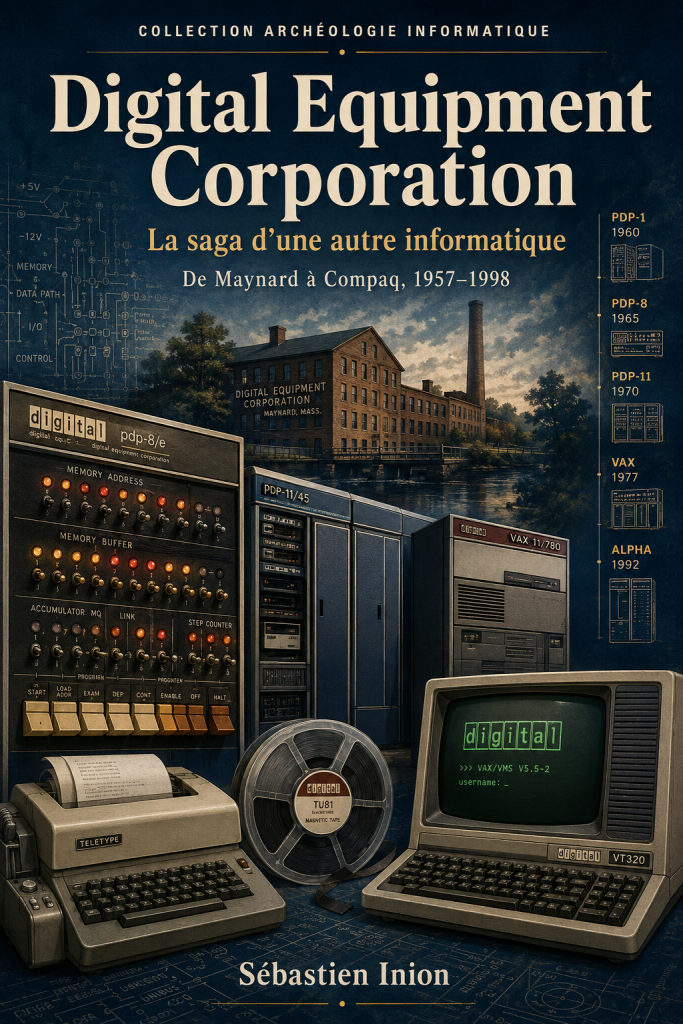
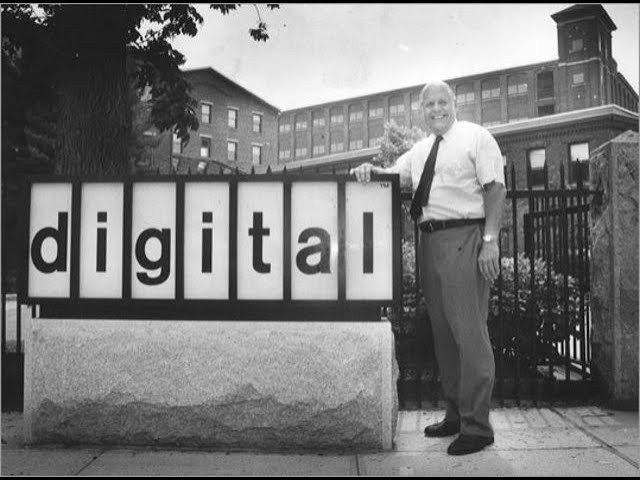
The company established its headquarters in Maynard, Massachusetts, inside a former woollen mill that became closely associated with Digital’s identity.
At first, DEC did not manufacture complete computers. Instead, it sold logic modules and electronic building blocks for scientific instrumentation and digital systems.
This activity allowed the company to develop its engineering and manufacturing expertise. It also prepared DEC for a more ambitious goal: building complete computer systems.
A crucial source of early funding came from the American Research and Development Corporation (ARD), led by Georges Doriot. ARD provided DEC with $70,000 in initial capital.
The minicomputer revolution
At the beginning of the 1960s, computing was dominated by mainframes. These systems were powerful, expensive and highly centralised. They also required specialised staff and dedicated computer centres.
DEC challenged this model with smaller and less expensive machines that could be placed much closer to their users.
These systems became known as the Programmed Data Processor (PDP) family.
- PDP-1 (1960): DEC’s first computer and an important machine in the development of interactive computing in laboratories and universities.
- PDP-8 (1965): the first mass-produced minicomputer and one of DEC’s greatest commercial successes. It was widely used in laboratories, industrial control, data acquisition and education.
- PDP-11 (from 1970): one of the most influential minicomputer families ever produced. PDP-11 systems were used in industry, research, embedded systems and higher education.
DEC’s central idea was simple: computers should be sufficiently affordable and practical to become everyday working tools.
As a result, computing gradually moved closer to engineers, researchers and programmers. The computer was no longer restricted to a distant central computing facility.
Major technological contributions
Interactive and multi-user computing
DEC strongly contributed to the spread of interactive computing and time-sharing.
Instead of submitting a program and waiting for an operator to run it, users could interact directly with the computer through terminals. This greatly shortened the cycle between programming, testing and debugging.
VAX: the “supermini”
In the late 1970s, DEC entered a new phase with the VAX architecture.
The VAX-11/780, introduced in October 1977, extended the PDP-11 architecture into a 32-bit environment. Together with the VMS operating system, the VAX family became extremely successful in universities, research centres and businesses.
The VT100 terminal
DEC also made an important contribution to human-computer interaction.
Introduced in 1978, the VT100 was DEC’s first ANSI-compliant video terminal. It became one of the most influential computer terminals of its generation.
Its control sequences helped establish conventions that remain visible in modern terminal emulators and Unix-like environments.
DECnet and computer networking
In 1975, DEC introduced DECnet, a network architecture designed to connect Digital computers.
DECnet allowed PDP and later VAX systems to communicate across distributed networks. Long before public access to the Internet became widespread, networking had therefore become a central part of DEC’s computing environment.
Alpha and 64-bit computing
In 1992, DEC announced the Alpha architecture.
Alpha was a high-performance 64-bit RISC architecture designed for workstations and servers. Its first generation included the Alpha 21064 processor and a new range of 64-bit systems.
Alpha demonstrated that DEC remained capable of major processor innovation even during the company’s difficult final decade.
Rise and decline
The success of the PDP and VAX families transformed DEC into one of the world’s largest computer companies.
By 1988, Digital was second only to IBM among the world’s largest computer companies.
However, the computer industry was changing rapidly. Personal computers became increasingly powerful, while standardised servers and open architectures challenged the traditional minicomputer market.
DEC struggled to adapt its organisation and product strategy to this new environment. Despite technologies such as Alpha, the company gradually lost its dominant position.
In January 1998, Compaq announced its acquisition of Digital Equipment Corporation for approximately $9.6 billion.
The acquisition brought an end to DEC as an independent company.
Timeline – Digital Equipment Corporation (DEC)
- 1957: Digital Equipment Corporation is founded in Maynard, Massachusetts, by Ken Olsen and Harlan Anderson.
- 1960: the PDP-1, DEC’s first computer, is delivered.
- 1965: introduction of the PDP-8, the first mass-produced minicomputer.
- 1969: introduction of the PDP-12, successor to the LINC-8.
- 1970: introduction of the PDP-11 family and its UNIBUS architecture.
- 1971: introduction of the PDP-11/45 and the RSTS-11 time-sharing operating system.
- 1973: introduction of RSX-11D, a real-time operating system for the PDP-11.
- 1975: introduction of DECnet, Digital’s network architecture.
- 1977: introduction of the VAX-11/780, the first member of the 32-bit VAX family.
- 1978: introduction of the VT100, DEC’s first ANSI-compliant video terminal.
- 1983: DEC announces VAXclusters, allowing several VAX systems to operate as a highly available computing environment.
- 1984: the MicroVAX I brings the VAX architecture to smaller and less expensive systems.
- 1988: DEC is second only to IBM among the world’s largest computer companies.
- 1989: introduction of the VAX 9000, DEC’s last major VAX system not based on microprocessor technology.
- 1992: announcement of the 64-bit Alpha RISC architecture.
- 1992: OpenVMS/AXP V1.0 is released for the first generation of Alpha systems.
- 1998: Digital Equipment Corporation is acquired by Compaq.
- 2002: Compaq merges with Hewlett-Packard, bringing much of DEC’s technological legacy into HP.
Télécharger gratuitement le livre
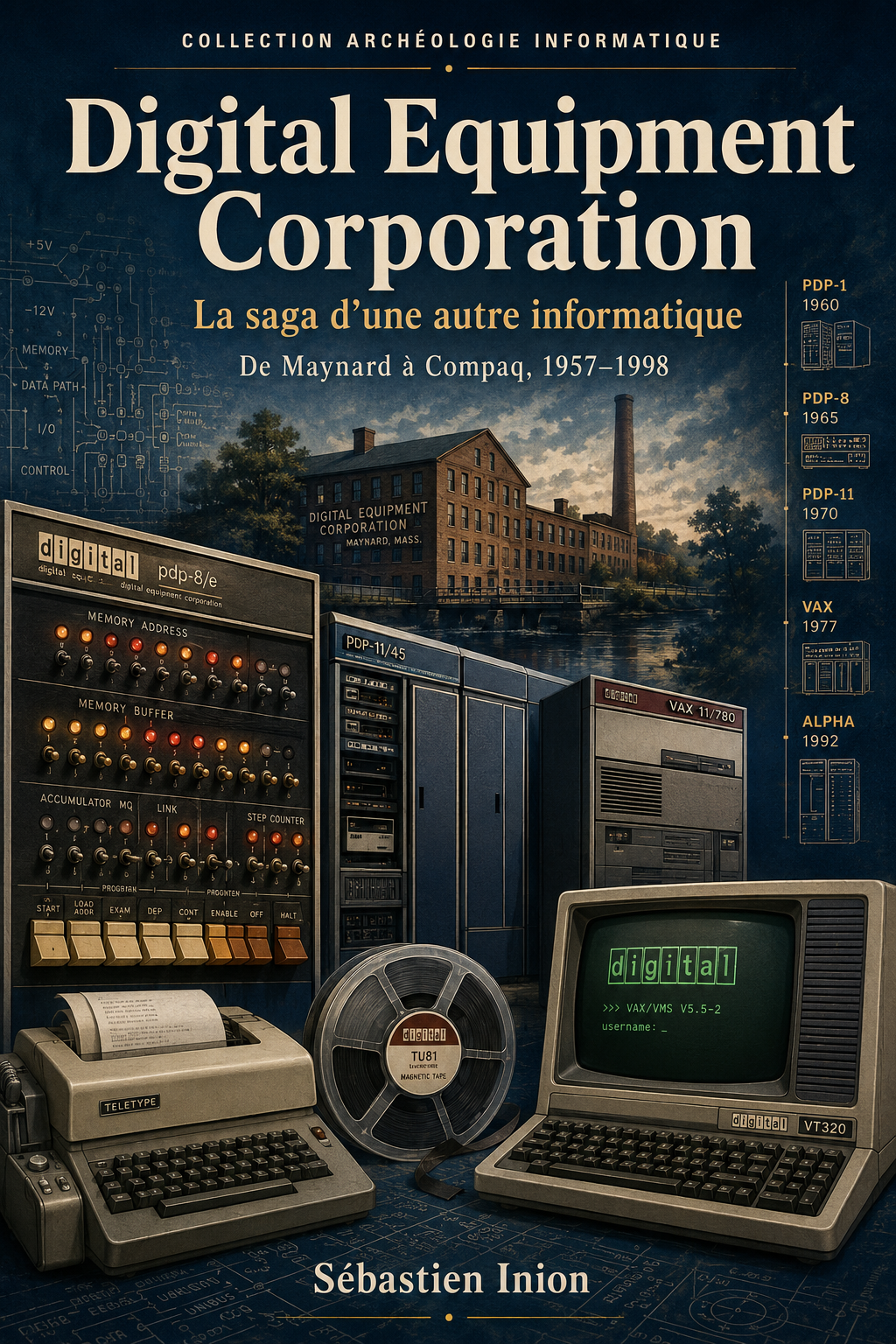
Pour approfondir l’histoire de DEC, je propose gratuitement Digital Equipment Corporation — La saga d’une autre informatique, un ouvrage consacré à l’entreprise, aux familles PDP, VAX et Alpha, ainsi qu’à sa culture technique.