Ada Lovelace
Ada Lovelace: Countess, Mathematician and Poet of Science
Ada Lovelace occupies a unique place in the history of computing. A British mathematician born in 1815 and the daughter of the poet Lord Byron, she is often described as the world’s first computer programmer because of the algorithm she published for Charles Babbage’s Analytical Engine.
Yet reducing Ada Lovelace to that famous title misses what is perhaps most remarkable about her work. She understood that a programmable machine could eventually manipulate much more than numbers. If information could be represented through symbols and governed by formal rules, a machine might process it — potentially including music.
This vision emerged from what Ada herself called “poetical science”: an attempt to combine mathematical rigour with imagination. More than a century before electronic computers appeared, she was already thinking about what a general-purpose computing machine could become — and about the limits of what such a machine could do.
Quick facts
- Full name: Augusta Ada King, Countess of Lovelace
- Born: 10 December 1815, London
- Died: 27 November 1852
- Fields: mathematics, symbolic computation
- Key collaborator: Charles Babbage
- Major work: Notes on the Analytical Engine (1843)
- Famous algorithm: method for calculating Bernoulli numbers
Between poetry and mathematics: “poetical science”
Ada was the only legitimate child of the poet Lord Byron and Anne Isabella Milbanke, usually known as Annabella. Her parents separated shortly after her birth, and Ada never developed a personal relationship with her father.
Her mother feared that Ada might inherit what she regarded as Byron’s unstable and excessively romantic temperament. Mathematics and disciplined study therefore became an important part of Ada’s education.
The result was not the suppression of her imagination. Instead, Ada gradually brought the two worlds together.
She developed an approach she called “poetical science”: mathematics could describe the world, but imagination could reveal unexpected connections between ideas.
This combination would later become essential to the way she interpreted Charles Babbage’s machines. Where others saw gears performing calculations, Ada began to imagine something far more general.
An unusual scientific education
For a young aristocratic woman in early nineteenth-century Britain, Ada received an unusually serious education in mathematics and science.
Among the people who influenced her was Mary Somerville, one of the most respected scientific writers and mathematicians in Britain. Somerville became both a friend and an intellectual mentor.
Ada later studied advanced mathematics with Augustus De Morgan, a prominent mathematician and logician. Her surviving correspondence shows that she struggled with difficult concepts, asked questions and worked through mathematical problems with considerable determination.
This matters because Ada Lovelace is sometimes portrayed simply as a gifted amateur fascinated by Babbage. Her intellectual development was more substantial: she actively worked to acquire the mathematics needed to understand the machine she would later describe.
1833: meeting Charles Babbage
Ada met Charles Babbage in 1833, when she was seventeen. Babbage was already known for his work on mechanical calculating machines.
He showed visitors a portion of his Difference Engine, a mechanical machine designed to calculate numerical tables automatically.
Ada was fascinated.
But Babbage soon moved toward a far more ambitious design: the Analytical Engine.
The distinction is essential. The Difference Engine was designed mainly to perform a specialised class of numerical calculations. The Analytical Engine was conceived as a machine whose operations could be changed by instructions.
In modern language, it was a proposal for a general-purpose programmable machine.
The Analytical Engine: far more than a calculator
Babbage’s design contained concepts that are strikingly familiar today.
The machine included a “store” in which values would be held and a “mill” where operations would be performed. These can loosely be compared with memory and a processing unit in a modern computer.
Instructions and data could be supplied through punched cards. Babbage took inspiration from the Jacquard loom, which used punched cards to control complex patterns woven into fabric.
This connection made a deep impression on Ada.
A machine did not necessarily have to be physically rebuilt each time a new operation was required. Change the sequence of instructions, and the same mechanism could perform a different task.
That is one of the central ideas of programmable computing.
1843: a translation that became an original work
In 1842, the Italian engineer Luigi Federico Menabrea published a French description of Babbage’s Analytical Engine after attending one of his presentations in Turin.
Ada translated the paper into English.
But she did much more than translate it.
At Babbage’s suggestion, she added a series of explanatory sections known as Notes A to G. Published in 1843 under her initials A.A.L., these notes became considerably longer than Menabrea’s original article.
They explained how the Analytical Engine might operate, examined possible applications and explored the conceptual consequences of a programmable machine.
The correspondence between Lovelace and Babbage also shows that this was genuine intellectual collaboration. Babbage supplied important technical knowledge, but Ada made her own choices, developed explanations and worked through mathematical problems. Babbage later acknowledged her contribution and even recalled that she had identified an error in one of his calculations.
Note G and the Bernoulli numbers
The most famous part of Ada’s work appears in Note G.
There, she described a sequence of operations by which the Analytical Engine could calculate Bernoulli numbers, a sequence of rational numbers with important applications in mathematics.
Ada did not simply state the mathematical formula. She constructed a detailed table showing how the machine would proceed through the calculation, how values would move between its components and in which order the operations should occur.
In other words, she translated a mathematical procedure into a form intended for execution by a machine.
The Analytical Engine was never completed, so the procedure was never executed on the machine for which it was written.
Was Ada Lovelace really the first programmer?
Ada Lovelace is frequently called the first computer programmer. The description is useful, but it requires some historical nuance.
Babbage had already devised procedures for his machines, and the development of the Bernoulli calculation took place within a close collaboration between them.
What makes Ada’s Note G exceptional is that it provides one of the earliest published detailed descriptions of an algorithm specifically intended for execution by a programmable general-purpose machine.
Calling it the first published computer program of its kind is therefore more precise than imagining Ada working in complete isolation as a modern software developer.
The distinction does not diminish her achievement. On the contrary, it allows us to see that her most important contribution went beyond a single algorithm.
The real conceptual leap: from numbers to symbols
This is where Ada Lovelace becomes particularly important to the history of computing.
Most calculating machines were conceived as devices for manipulating numbers. Ada realised that the numbers inside a machine did not necessarily have to represent quantities.
They could represent something else.
If objects or relationships could be expressed symbolically and governed by formal rules, the Analytical Engine could theoretically operate on those symbols.
That idea brings her surprisingly close to the fundamental principle of modern digital computing: computers manipulate encoded information, and the meaning of that information depends on how we choose to represent it.
Text, images, sound and many other forms of information can ultimately be represented symbolically and processed by a machine.
Ada was not describing digital encoding in its modern technical form. But she had grasped the broader idea that computation could extend beyond arithmetic.
Could a computer create music?
Ada offered an extraordinary example.
If the relationships between musical sounds could be expressed formally, she suggested, a machine such as the Analytical Engine might manipulate those relationships and produce elaborate musical compositions.
For the 1840s, this was an astonishing idea.
The machine did not yet exist. Electronic computers were still a century away. Yet Ada was already imagining computation applied to something we would now call digital media or computer-generated content.
Her insight was not that the Analytical Engine itself could suddenly play music. It was that a programmable machine could potentially operate on any sufficiently formalised symbolic system.
This is one of the clearest expressions of her “poetical science”: a technical idea extended by imagination into unexplored territory.
A machine that could “weave” operations
Ada used the Jacquard loom to explain this new relationship between instructions, symbols and machines.
A Jacquard loom followed punched-card instructions to weave intricate patterns into fabric. In a similar way, she imagined the Analytical Engine combining operations according to instructions encoded on cards.
Her famous metaphor compared the machine’s manipulation of mathematical relations to a loom weaving patterns.
The analogy is remarkably effective because it explains programmability without requiring modern computer terminology: the mechanism remains the same, while the instructions determine what it produces.
Repetition, choices and reusable operations
Ada also examined how sequences of operations could be repeated and reused.
The punched-card system would allow a series of instructions to be applied again rather than requiring every operation to be described from the beginning. Babbage’s design also allowed the sequence of operations to change according to intermediate results.
These ideas anticipate concepts that later became fundamental to programming: iteration, reusable sequences of instructions and conditional branching.
We should not simply project modern programming terminology onto the 1840s. Nevertheless, Ada clearly understood that the power of the Analytical Engine depended not only on calculation, but on the organisation and sequencing of operations.
A collaborator who stood up to Babbage
The relationship between Lovelace and Babbage was intellectually productive but not always peaceful.
During the preparation of the 1843 publication, Babbage wanted to associate his criticism of the British government’s refusal to finance his machines with the publication surrounding Ada’s work.
Ada refused to let her scientific contribution become the vehicle for his political dispute.
Their correspondence became heated.
The episode is revealing. Ada was not merely Babbage’s assistant or admirer. She regarded the Notes as her own scientific work and was prepared to defend how they would be presented.
She later proposed a more formal partnership in which she would use her writing skills and social connections to help promote the Analytical Engine while taking a greater role in its strategy. Babbage did not accept the arrangement.
Their friendship nevertheless survived. He would affectionately refer to her as the “Enchantress of Numbers.”
Can a machine create or think?
Ada also raised a question that sounds strikingly contemporary.
Could a machine originate something genuinely new?
She argued that the Analytical Engine could perform whatever operations humans knew how to instruct it to perform, but that it could not originate intentions or ideas by itself.
More than a century later, Alan Turing discussed this argument in his 1950 paper Computing Machinery and Intelligence. It became known as “Lady Lovelace’s Objection.”
The question has never really disappeared.
When a computer generates music, images, text or computer programs, is it creating? Or is it executing and recombining rules, instructions and information ultimately provided by humans?
Ada Lovelace was already approaching this philosophical boundary in 1843.
More important than the title “first programmer”
The debate over whether Ada Lovelace should be called the first programmer is historically interesting. But focusing exclusively on that title can actually make her contribution seem smaller.
Her Bernoulli algorithm was important.
Her broader vision was more remarkable.
Ada understood that a programmable machine could become something fundamentally different from a calculator. Its operations could be changed. Instructions could be organised and repeated. Most importantly, the symbols processed by the machine could represent things other than numerical quantities.
She was therefore thinking not only about how to calculate with a machine, but about what a programmable machine could ultimately be used to do.
That distinction places her remarkably close to the conceptual foundations of modern computing.
Why Ada Lovelace is a major figure
- Programming: her Note G contains one of the earliest published detailed algorithms designed for execution by a programmable machine.
- General-purpose computing: she clearly understood the difference between a specialised calculator and a machine that could be reprogrammed for different tasks.
- Symbolic information: she recognised that computation could potentially manipulate symbols representing more than numerical quantities.
- Computer-generated music: she imagined a machine operating on formalised musical relationships more than a century before digital music.
- Limits of machines: her reflections on whether machines could originate ideas later entered the history of artificial intelligence through Alan Turing.
- Poetical science: she combined mathematical reasoning and imagination in a way that remains surprisingly modern.
Timeline
- 1815: Ada Byron is born in London on 10 December.
- 1833: she meets Charles Babbage and sees his calculating machinery.
- 1835: she marries William King.
- 1838: she becomes Countess of Lovelace.
- 1842: Luigi Menabrea publishes his French description of the Analytical Engine.
- 1843: Ada’s English translation and Notes A–G are published.
- 1852: Ada Lovelace dies at the age of 36.
- 1950: Alan Turing discusses what becomes known as “Lady Lovelace’s Objection.”
- 1980: the programming language Ada is named in her honour by the U.S. Department of Defense.
Sources and further reading
- Luigi Federico Menabrea and Ada Lovelace, Sketch of the Analytical Engine Invented by Charles Babbage, including Lovelace’s Notes.
- Computer History Museum — Charles Babbage and Ada Lovelace.
- Alan M. Turing, Computing Machinery and Intelligence, Mind, 1950.
- Walter Isaacson, The Innovators: How a Group of Hackers, Geniuses, and Geeks Created the Digital Revolution, 2014.
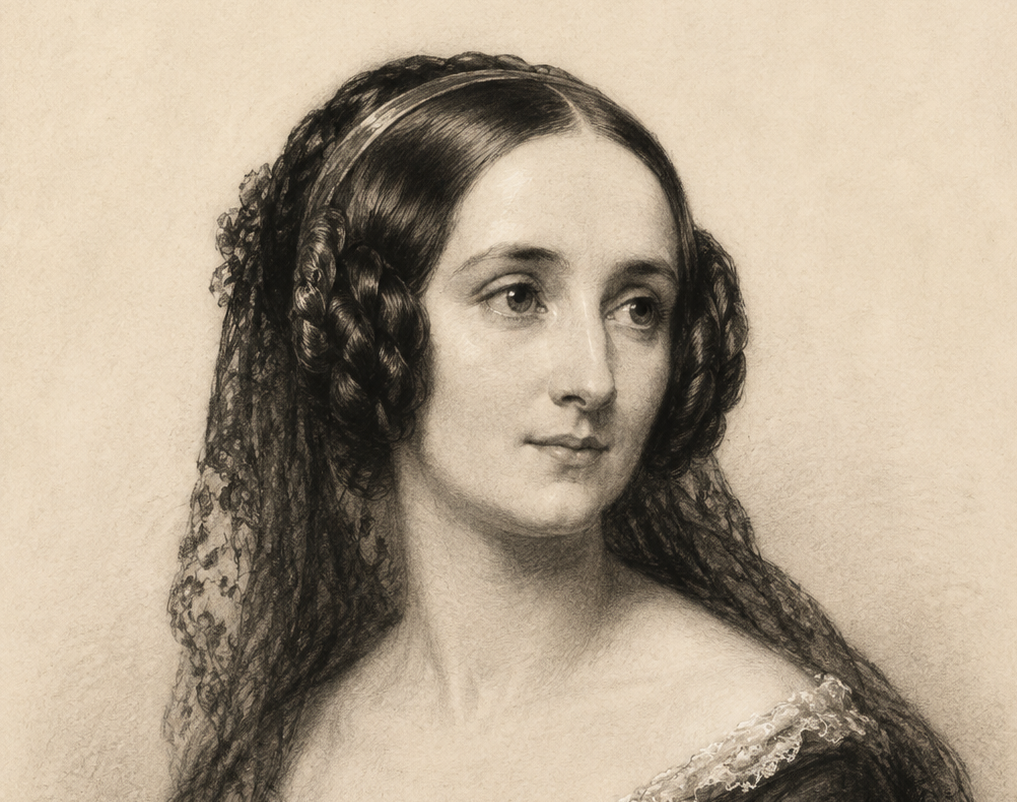
Cover illustration: original charcoal portrait of Ada Lovelace, created with the assistance of artificial intelligence from historical nineteenth-century representations.