Charles Babbage
Charles Babbage: from the Difference Engine to the programmable computer
Charles Babbage is one of the founding figures in the history of automatic computing. A British mathematician, inventor and scientific reformer, he designed two radically new families of machines during the 19th century: the Difference Engines, specialised machines intended to perform certain numerical calculations, and later the far more ambitious Analytical Engine, a design for a general-purpose programmable mechanical computer.
None of his major machines was completed during his lifetime. Nevertheless, the plans for the Analytical Engine contain several principles later found in computers: a memory separated from the calculating unit, instructions supplied by punched cards, input and output mechanisms, and the ability to perform repetitions and conditional operations.
Babbage therefore moved from the idea of automating a particular type of calculation to the much more ambitious concept of building a general machine controlled by a program.
What were these machines designed to do?
During the 19th century, scientists, astronomers, engineers and navigators relied heavily on printed numerical tables. These tables contained values calculated in advance, allowing users to avoid repeating long and complicated calculations by hand. Astronomical and nautical tables were particularly important for determining positions and performing navigation calculations.
Producing these tables, however, required large amounts of human calculation followed by transcription and typesetting. An error introduced at any stage could therefore appear in the published table.
Babbage wanted to mechanise this chain of calculation so that numerical results could be produced more quickly and with fewer human errors.
His Difference Engines were designed to calculate sequences of values automatically using the mathematical method of finite differences. This technique makes it possible, in particular, to evaluate polynomial functions using essentially addition.
A polynomial function is a mathematical formula that calculates a value from a number, for example f(x) = x² + 2x + 3. Such functions can be used directly or to generate numerical tables required in science and engineering. Babbage also planned to automate the printing of the results in order to reduce transcription errors.
The Analytical Engine represented a very different ambition. It was not designed for one particular class of numerical tables. Using instructions supplied notably through punched cards, it was intended to perform different sequences of operations according to a program.
By changing the instructions, the same machine could therefore solve different problems. It is this transition that conceptually brings Babbage’s design much closer to the programmable computer.
Quick facts
- Born: 26 December 1791
- Place of birth: England; institutional sources differ between London and Teignmouth, Devon
- Died: 18 October 1871, London
- Fields: mathematics, mechanical computation, engineering
- Major contributions: Difference Engine No. 1, Analytical Engine, Difference Engine No. 2
- Important collaborators: Joseph Clement, Ada Lovelace
Cambridge and the reform of British mathematics
Babbage entered Trinity College, Cambridge, in 1810. He was already familiar with much of the mathematics being taught and became dissatisfied with what he regarded as Britain’s backwardness in some areas of calculus.
With other students, including John Herschel and George Peacock, he helped establish the Analytical Society, which sought, among other things, to introduce into Britain the methods and notation of differential calculus used in continental Europe.
This organisation was not directly connected with the later Analytical Engine, despite the similarity of the names. It does, however, reveal a lasting feature of Babbage’s work: his interest in formalisation, systematic methods and the improvement of scientific tools.
Elected a Fellow of the Royal Society in 1816, Babbage became an important member of the British scientific community.
In 1828, he was elected to the prestigious Lucasian Professorship of Mathematics at Cambridge. His interests, however, extended far beyond academic mathematics. Babbage studied manufacturing, railways, statistics and scientific instruments, and became particularly interested in the possibility of transferring repetitive intellectual operations to automatic mechanisms.
The problem of numerical tables
At the beginning of the 19th century, astronomy, navigation, engineering, insurance and many scientific activities depended on extensive numerical tables.
Human computers calculated the values, other workers copied them, and printers then typeset the pages. Errors could be introduced at every stage of this process.
Babbage and John Herschel were themselves involved in checking mathematical tables. In 1821, the accumulation of errors helped convince Babbage that a machine could automate the work.
His objective was therefore not simply to make arithmetic faster. He wanted to mechanise the entire process, from calculation to printing, in order to reduce calculation, transcription and typesetting errors.
This distinction is important. Babbage’s first ambition was not yet to build a universal computer. His immediate goal was a specialised machine capable of automatically producing reliable mathematical tables.
The Difference Engine: calculating with addition
Babbage’s first major response to this problem was the Difference Engine No. 1. Its principle relied on the method of finite differences, which can calculate polynomial values through successive additions.
This property was especially attractive for a mechanical calculating machine because addition is considerably easier to implement with gears than multiplication or division.
A simple example illustrates the principle. Consider the square numbers:
0, 1, 4, 9, 16…
The first differences are:
1, 3, 5, 7…
and the second differences remain constant:
2, 2, 2…
By repeatedly adding these differences, a machine can generate the next square numbers without directly multiplying each number by itself.
The Difference Engine was therefore not a general-purpose computer. It mechanically applied a particular mathematical method to a class of functions.
Babbage nevertheless planned something remarkable: the calculated results were to be transferred automatically to a printing mechanism and potentially to equipment capable of producing printing plates. Calculation and publication could thus become part of a single automated process.
A gigantic mechanical project
In 1823, the British government funded the construction of a large Difference Engine. Babbage worked with Joseph Clement, one of Britain’s leading precision mechanics and toolmakers.
The project soon grew enormously in scale.
The 1830 design for Difference Engine No. 1 was intended to calculate with sixteen-digit numbers and six orders of differences. The complete machine would have required approximately 25,000 parts and weighed around four tons.
Costs increased, construction progressed slowly, and relations between Babbage and Clement deteriorated.
In 1832, Clement nevertheless completed a demonstration section containing approximately 2,000 parts. It represented only part of the calculating mechanism, but it worked and demonstrated the validity of Babbage’s mechanical principles.
A financial and organisational dispute brought construction to a halt during 1832–1833. The British government finally ended its financial support for the project in 1842.
1834: from a specialised calculator to a general machine
The failure to complete the first Difference Engine did not end Babbage’s research. Instead, in 1834, he began designing a far more ambitious system: the Analytical Engine.
The change was fundamental.
The Difference Engine had a purpose largely determined by its mechanical design. The Analytical Engine was intended to perform different calculations according to a sequence of instructions.
Babbage was therefore no longer designing only a specialised calculating mechanism. He was developing a general architecture whose behaviour could be determined by the program supplied to it.
His designs evolved continuously, and several versions of the Analytical Engine exist in his papers. It is therefore more accurate to describe it as an evolving architectural project rather than as a single machine whose characteristics were completely fixed in 1834.
The “Store” and the “Mill”: memory and processing
Babbage’s architecture separated two major components.
The Store, which can cautiously be compared with computer memory, held numbers and intermediate results.
The Mill performed arithmetic operations. Mechanical systems transferred values between these two parts of the machine.
This separation between storage and processing is one of the most modern aspects of the design.
The Analytical Engine was also intended to support several forms of output, including printing on paper, punching cards, plotting graphics and producing material for the manufacture of printing plates.
Despite its entirely mechanical construction, the Analytical Engine was a decimal digital machine in the sense that it manipulated discrete numerical states. Each decimal digit was represented by the position of a wheel.
Babbage considered other numerical bases, including binary representation, but ultimately retained decimal arithmetic for practical engineering and usage reasons.
Punched cards: the program becomes external to the mechanism
To control the machine, Babbage adapted the principle of punched cards used in the looms associated with Joseph-Marie Jacquard.
In a Jacquard loom, a sequence of cards determines the pattern woven into the fabric without requiring the loom itself to be rebuilt. Babbage applied a comparable principle to calculation.
Sequences of cards were intended to specify operations and help organise the processing of data.
The Analytical Engine also incorporated mechanisms for the repetition of sequences of operations and forms of conditional branching: the ability to alter the sequence of operations depending on a result produced during a calculation.
These capabilities are crucial. The same mechanism could perform different processes depending on the cards supplied to it. The machine therefore became programmable.
It was not, however, a stored-program computer in the sense introduced by electronic computers more than a century later. Its instructions remained encoded on external cards rather than being stored internally in the same memory as the data.
A mechanical machine that resembles a computer
Using modern computer terminology to describe a 19th-century machine requires caution. Nevertheless, the similarities are real.
The Store resembles memory. The Mill resembles a processing unit. Cards provide instructions and data, while various mechanisms handle the output.
More importantly, loops and conditional branching make it possible to organise calculations whose execution is not limited to a fixed sequence of operations.
It is this general computational logic, rather than the gears themselves, that makes the Analytical Engine such an important milestone in the history of programmable computing.
It would nevertheless be misleading to describe it simply as a modern computer built from brass a century ahead of its time. Its architecture, programming model, technology and operation remained deeply rooted in the mechanical world of the 19th century.
Its historical importance lies precisely in both the similarities and the differences between Babbage’s design and later computers.
Ada Lovelace: explaining what the machine could do
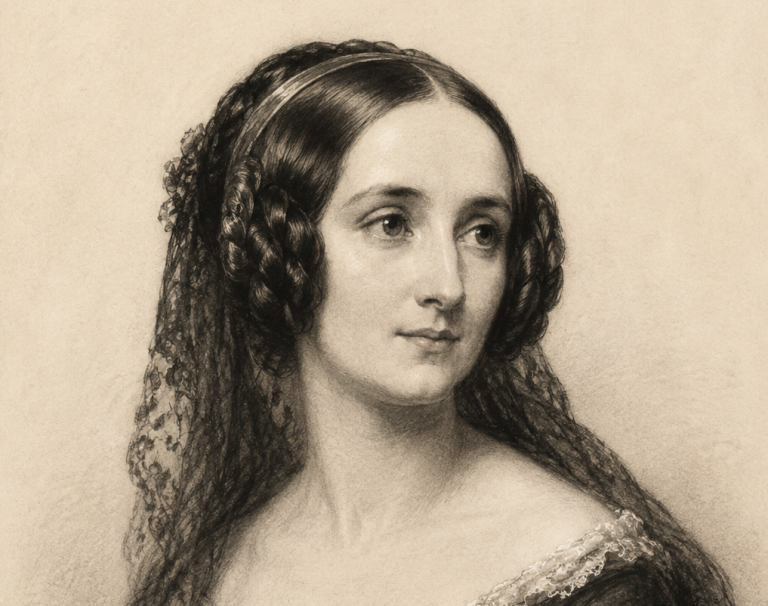
Babbage met Ada Lovelace in 1833. The young mathematician became deeply interested in his machines and was one of the people able to understand the wider implications of the Analytical Engine.
In 1840, Babbage presented his project in Turin. The Italian engineer Luigi Federico Menabrea subsequently published a French account of the lectures.
Lovelace translated Menabrea’s text into English and, in 1843, added a series of Notes that were substantially longer than the original article.
Her Notes explain the logic of the machine, the organisation of its cards and several computational procedures. The famous Note G describes, among other things, a procedure involving the Bernoulli numbers.
It is often described as the first published computer program, although historians continue to discuss the application of this modern term and the precise division of contributions between Lovelace and Babbage.
One of Lovelace’s most original contributions also lay in her understanding of the machine’s potential. She explicitly recognised that such a machine could manipulate symbols representing things other than numerical quantities, provided that those objects could be expressed through suitable rules.
Babbage supplied the architecture and mechanisms; Lovelace made a major contribution to explaining their logic and wider significance.
Why did Babbage fail to build his machines?
The answer cannot simply be reduced to the claim that “19th-century technology was not advanced enough.”
Mechanical precision certainly presented a major challenge, but the difficulties were also financial, political and personal.
The cost of the first project increased dramatically, the dispute with Joseph Clement paralysed construction, and the British government’s confidence gradually disappeared.
Babbage himself contributed to these difficulties. A perfectionist, he frequently revised his designs and moved on to the Analytical Engine while the first Difference Engine remained unfinished.
His relationships with institutions and some scientific officials could also become contentious. From the government’s perspective, the project was becoming increasingly expensive without producing a complete machine ready for practical use.
The Analytical Engine was even more complex than the first project. Babbage continued revising and documenting it for the rest of his life but never obtained the funding required to construct the complete machine.
Difference Engine No. 2: the machine built 150 years later
Between 1847 and 1849, Babbage returned to the principle of the Difference Engine and designed the Difference Engine No. 2.
His work on the Analytical Engine allowed him to simplify the mechanism considerably. The new design was intended to calculate with 31-digit numbers and tabulate seventh-order polynomials using approximately 8,000 parts.
Babbage never attempted to build it.
More than a century later, however, the Science Museum in London began constructing the machine from Babbage’s drawings.
The project, led by Doron Swade, began in 1985. The calculating section was completed in 1991, followed by the printing and stereotyping apparatus in 2002.
The result is extremely important in evaluating Babbage’s work: the machine operated as intended.
The builders also deliberately avoided using manufacturing tolerances more precise than those achievable during the 19th century. The experiment demonstrated that the manufacturing limitations of Babbage’s era cannot, by themselves, explain the failure of the original project.
An inventor whose work went far beyond calculating machines
Babbage’s interests extended well beyond mechanical computation.
He participated in the development of several British scientific institutions and studied statistics, manufacturing and industrial organisation. He also devised numerous mechanical systems.
These activities reflected a common conviction: scientific methods and mechanisation could improve processes that had previously depended heavily on manual work and individual experience.
When Babbage died in London on 18 October 1871, none of his major calculating machines had been completed.
His archives, however, preserved an extraordinary collection of drawings, notations and notebooks. Detailed study of these documents during the 20th century, followed by the construction of Difference Engine No. 2, allowed historians and engineers to assess the scale and sophistication of his work much more accurately.
Why Charles Babbage is a major figure in computing history
- Automation of calculation: he sought to reduce human error by mechanising not only calculation but also the production of printed mathematical tables.
- Difference Engine: he designed a specialised machine capable of mechanically applying the method of finite differences.
- Analytical Engine: he moved from the specialised calculator to the idea of a general machine whose behaviour would depend on supplied instructions.
- Architecture: his Store and Mill anticipate the separation between storage and processing, while the machine also included several forms of input and output.
- Programming: punched cards, repetition and conditional branching made it possible to envisage complex procedures without rebuilding the mechanism.
- Later validation: the Science Museum’s construction of Difference Engine No. 2 demonstrated the mechanical viability of at least one of his major designs.
- Conceptual importance: his work anticipated several fundamental principles of computing while remaining historically distinct from the electronic computer revolution of the 20th century.
Timeline
- 1791: Charles Babbage is born on 26 December
- 1810: enters Trinity College, Cambridge
- 1811: participates in the creation of the Analytical Society
- 1816: elected a Fellow of the Royal Society
- 1821: develops the idea of automating the production of numerical tables
- 1822: builds a small experimental model of a Difference Engine
- 1823: the British government begins funding the large Difference Engine project
- 1832: the demonstration fragment of Difference Engine No. 1 is completed
- 1832–1833: construction stops following the dispute with Joseph Clement
- 1833: meets Ada Lovelace
- 1834: begins designing the Analytical Engine
- 1840: presents the Analytical Engine in Turin
- 1842: British government funding for Difference Engine No. 1 finally ends
- 1843: publication of Lovelace’s translation of Menabrea and her extensive Notes
- 1847–1849: designs Difference Engine No. 2
- 1871: Charles Babbage dies in London
- 1991: the Science Museum completes the calculating section of Difference Engine No. 2
- 2002: its printing and stereotyping apparatus is completed
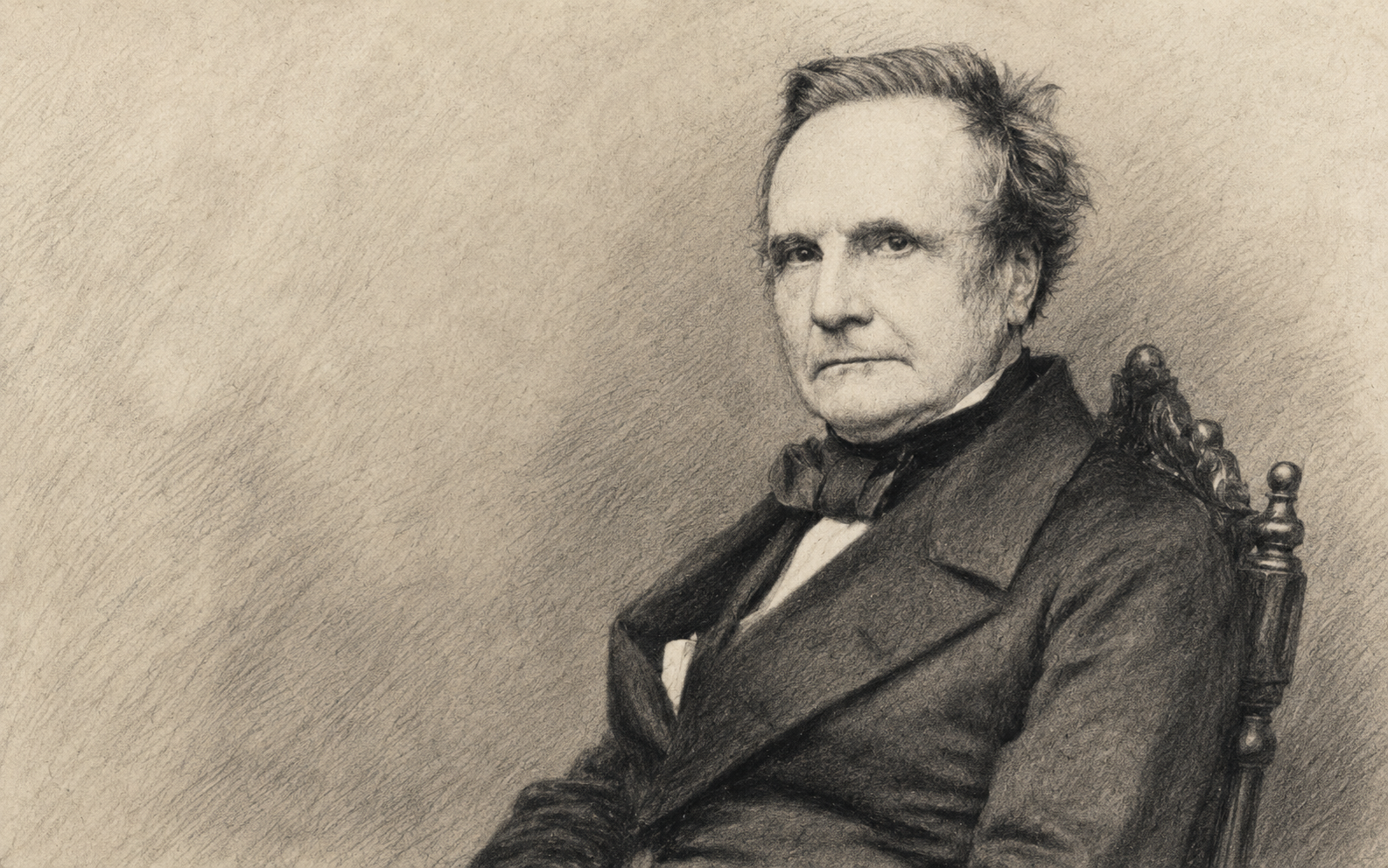
Cover illustration: AI-generated portrait of Charles Babbage created with ChatGPT (OpenAI), based on a historical 19th-century photograph.